
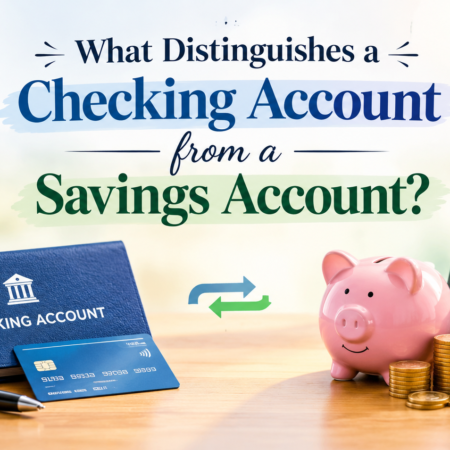
Choosing the right bank account is an essential first step in effectively managing your finances.
Checking and savings accounts are two typical alternatives that you have likely seen whether creating your first bank account or attempting to manage your finances.
Both accounts assist you in keeping your funds accessible and safe, but they have different functions. While a checking account is usually used for everyday costs, a savings account helps you save money for future needs.
You may avoid needless fees, develop better money habits, and make wiser financial decisions by knowing the difference between a checking account and a savings account.
We will analyse the features of each account, explain how they operate, and assist you in selecting the one that best suits your financial objectives in this guide.
A Checking Account: What Is It?
One kind of bank account used for routine financial transactions is a checking account.
It enables you to make purchases, pay bills, deposit money, and collect your pay cheque without frequently going to a bank location.
The majority of checking accounts include ATM withdrawals, online and mobile banking, and a debit card. You may also set up automatic bill payments and direct deposits with many banks.
Typical Applications for a Checking Account
A checking account can be used for:
- Get your pay cheque or salary via direct deposit.
- Make monthly payments for utilities, rent, and other costs.
- Buy clothing, groceries, and necessities for the home.
- Move funds to different accounts or individuals.
- Take money out of ATMs.
- Pay for recurring services and subscriptions
Benefits of Having a Checking Account
1. Simple access to your funds
When you need to pay regular bills, checking accounts make it easy to access your money.
2 .Easy ways to pay bills
For recurring invoices, you can set up automated payments to help you keep organised and lower the chance of missing deadlines.
3. Easy money management
You may learn where your money goes each month by reviewing your transactions using online or mobile banking.
4. Options for direct deposit
Many firms will transfer your pay cheque directly into your checking account.
A checking account’s drawbacks
Additionally, checking accounts may have the following disadvantages: * Monthly maintenance fees apply to certain accounts.
- To avoid costs, certain accounts have a minimum balance requirement.
- Depending on the account and transaction, overdraft fees might be incurred if you spend more than your available balance.
- A lot of checking accounts offer little to no interest on your balance.
Before opening an account, review the fee schedule, minimum balance requirements, ATM access, and overdraft limits.
A Savings Account: What Is It?
The purpose of a savings account is to assist you in setting aside funds for future needs and financial objectives. A savings account encourages you to set money aside instead of using it for everyday expenditures, as contrast to a checking account, which is mostly used for spending.
Your amount can increase over time because many savings accounts earn interest. The bank, the type of account, and the state of the market all affect interest rates.
Building an emergency fund, saving for a trip, getting ready for a big purchase, or putting money aside for unforeseen costs are all beneficial uses for savings accounts.
Typical Applications for Savings Accounts
A savings account can be used for: Create a fund for emergencies. • Put money aside for a trip or holiday. • Get ready for a household cost or auto repair. • Set aside funds for a down payment on a house. • Put money aside for future college costs. • Get interest on funds you don’t need to spend right now.
Benefits of a Savings Account
1. Get interest on your balance
Interest is paid on deposits made into many savings accounts. A higher interest rate may accelerate the growth of your savings, especially if you make consistent contributions.
2. Establish an emergency fund
It can be simpler to plan for unforeseen costs like medical bills, urgent auto repairs, or temporary income loss if you keep money elsewhere from your regular spending account.
3. Keep your savings and spending money separate.
The temptation to spend money meant for future objectives can be lessened with a designated savings account.
4. Possibility of obtaining favourable interest rates
Interest rates on some high-yield savings accounts are higher than those on conventional savings accounts. You can find competitive options by comparing annual percentage returns, or APYs.
A savings account’s drawbacks
There may be several restrictions on savings accounts: • Over time, interest rates may fluctuate. • A minimum balance is necessary for some accounts. • Some accounts may be subject to monthly maintenance fees. • Some banks charge fees under certain circumstances or restrict specific kinds of withdrawals or transfers. • Direct everyday purchases are typically less convenient with savings accounts
Before opening an account, see the account agreement for the most recent withdrawal policies, fees, and minimum balance requirements.
Important Distinctions Between Savings and Checking Accounts
The primary distinction between these accounts is what they are used for. A savings account is meant for money you want to save up for future needs, but a checking account is typically used for spending.
This is a straightforward comparison.
Features: Savings Account and Checking Account
The primary goal of daily expenditurePutting money aside for future objectives
Debit cards are widely accessible.Depending on the account
Bill payments are typically supported, though availability varies.
Interest income is frequently minimal or nonexistent.Frequently generates interest
ATM withdrawals are frequently accessibleUsually accessible, subject to conditions
Direct deposit is typically offered.Frequently accessible
Ideal for Everyday ExpensesFinancial objectives and emergency funds
The bank determines the fees.rely on the bank
Obtaining moneyAccessible and generally convenient, but there may be some limitations
Remember that each bank and account has different characteristics. Prior to selecting an account, always review the exact terms.
Can You Have a Checking Account and a Savings Account?
Indeed! Having both accounts can actually be a sensible approach to money management.
While a savings account enables you to put money aside for emergencies and future plans, a checking account helps you manage everyday spending.
Assume, for instance, that your monthly income after taxes is $3,500. This is how you could arrange your finances:
Amount of the Monthly Money Plan
$3,500 in take-home pay
$1,300 for utilities and rent
Transportation and groceries: $600
$400 for insurance and other expenses
$500 for personal expenses
$500 in savings
The remaining sum is $200.
In this scenario, you may pay your bills and everyday costs, deposit $500 into your savings account each month, and deposit your pay cheque into your checking account.
The leftover $200 could be put toward debt reduction or further savings, or it could remain in checking as a safety net.
These figures are merely an example. Your income, living expenses, debts, and financial priorities should all be reflected in your actual budget.
Which Account Is Best for You?
How you intend to utilise your money will determine which account is best for you.Select a checking account if
• To make regular purchases, you must have an account.
• You would like your pay cheque to be deposited directly into your account.
• You pay your monthly bills and rent on time.
• You must have easy access to your funds.
• You wish to keep track of all of your everyday transactions in one location.
Select a savings account if:
• You wish to accumulate money for emergencies.
• You’re saving money for a big buy.
• When you put money aside, you want to generate interest.
• Money that you do not want to spend right away needs to be kept in a different location.
• You wish to establish reliable saving practices.
If you’re looking for a more structured financial system, go for both.
Using both accounts offers a helpful balance between saving and spending for a lot of people.
You can transfer funds meant for future objectives into savings and keep enough cash in your checking account to cover impending obligations.
Because you won’t have to remember to manually transfer money each month, setting up an automated transfer after payday can make saving money easier.
A High-Yield Savings Account: What Is It?
A savings account that delivers a relatively high annual percentage return, or APY, is known as a high-yield savings account.
APY calculates the impact of compound interest over a 12-month period. It facilitates comparing the possible profits from several savings accounts.
For example, let’s say you deposit $5,000 into a savings account that yields 4% annually and you don’t make any additional deposits or withdrawals.Your debt would increase to about $5,200 if that rate stays the same for a year.
This implies that your interest before taxes would be around $200.
The account’s APY, compounding strategy, fees, and interest rate fluctuations all affect actual earnings. Since high-yield savings rates are frequently erratic, they could rise or fall over time.
Examine more than just the stated rate when comparing accounts. Verify the bank’s or credit union’s minimum deposit requirements, monthly fees, withdrawal regulations, and federal insurance status.
Are Savings and Checking Accounts Secure?
The Federal Deposit Insurance Corporation, or FDIC, typically protects checking and savings accounts at qualified FDIC-insured banks up to relevant limitations.
For each account ownership category, FDIC insurance typically covers eligible deposits up to $250,000 per depositor, each covered bank.
The National Credit Union Administration (NCUA) may provide comparable protection for eligible deposits in federally insured credit unions.
But not all of the financial products that banks and financial firms sell are covered by insurance. Cryptocurrency, stocks, and mutual funds are not covered by FDIC deposit insurance.
Check the institution’s insurance status and familiarise yourself with the relevant coverage guidelines before opening an account.
Advice for Taking Care of Your Savings and Checking Accounts
Effective use of both accounts doesn’t have to be difficult. You can stay on course by developing a few dependable behaviours.
1. Make sure you have enough cash on hand to cover future expenses.
To avoid overdrafts and missing payments, figure out your normal spending and have a fair balance.
2. Make your savings automatic.
If you have enough cash on hand for planned spending, set up an automated transfer from checking to savings after payday.
3. Examine account fees.
Seek out accounts that have no monthly maintenance costs or simple ways to waive them.
4. Consistently review your transactions.
To spot odd activity and comprehend your spending habits, review your bank statements and transaction history.
5. Examine APYs and interest rates.
Instead of assuming that all banks give the same rate when selecting a savings account, evaluate current APYs.
6. Gradually accumulate an emergency reserve.
Set a reasonable goal at first, like saving $500 or $1,000, then raise it as your budget permits. Based on your basic living costs, you can gradually increase the size of your emergency fund.
7. Safeguard your financial data.
When multifactor authentication is available, use strong, one-of-a-kind passwords, and refrain from disclosing your account information to unreliable people or websites.
Common Questions
1. Is it preferable to have a checking account over a savings account?
In general, neither account is superior. While a savings account is better suited for conserving money and maybe generating interest, a checking account is typically preferable for regular expenses and bill payments.
2. Is it possible to move funds from checking to savings?
Indeed. Although transfer time, costs, and limitations may differ, the majority of banks permit transfers between checking and savings accounts. Automatic repeating transfers are frequently possible to set up.
3. Should I maintain a checking account with all of my money?
Although it would be simple to keep all of your money in a checking account, doing so could make saving more challenging and result in missed interest. Think about transferring funds for future objectives into savings and keeping spending money in checking.
4. Do savings accounts generate income each month?
The bank’s account terms determine how interest is computed and credited. While posting schedules and calculating techniques can differ, some accounts credit interest on a monthly basis.
5. Can I use a savings account to pay bills directly?
While checking accounts are typically more practical for regular bill payments, certain financial institutions permit specific payments or transfers from savings accounts. Examine the benefits and limitations of the account.
6. What is the recommended amount of money for my checking account?
Try to save enough for regular expenses, future debts, and a fair safety net for unforeseen emergencies. Your spending patterns and income schedule will determine the appropriate amount
7. How much should I set aside each month?
There isn’t a single quantity that suits everyone. After necessary debt repayments and necessities, start with a sum you can regularly afford. As your financial circumstances improve, increase the amount you contribute to your savings.
8. How does opening a savings or checking account impact my credit score?
Generally speaking, opening a regular checking or savings account has no direct impact on your credit score. However, your credit may be impacted by specific account-related events, such as outstanding debts sent to collections. When assessing applications, some banks could also look at specific banking reports.
Concluding Remarks
You may strengthen your financial foundation by learning the distinction between a checking account and a savings account.Receiving money, paying bills, and managing daily costs are all made easier with a checking account. With the possibility of collecting interest, a savings account enables you to put money aside for long-term financial objectives, future purchases, and emergencies.
For many, using both accounts simultaneously is the most sensible course of action. Transfer funds you wish to save into an appropriate savings account, keep your usual spending money in checking, and routinely examine account conditions and fees.
To begin, a complex financial structure is not necessary. Over time, managing your funds can be made easier by selecting the appropriate accounts and forming reliable financial habits.
Do you want to improve your money management skills?
Visit Readnovia.com for more beginner-friendly personal finance guides to learn about managing debt, creating better financial habits, budgeting, and saving money.
Disclaimer: This essay should not be interpreted as personal financial advice; rather, it is intended solely for educational reasons. Financial institutions and account types differ in terms of account features, interest rates, fees, and insurance coverage
Other Articles

An Introduction to Raising Interest on High-Yield Savings Accounts
ETF Investing for Novices: An Easy Guide to Beginning


No Comment! Be the first one.