

Overview
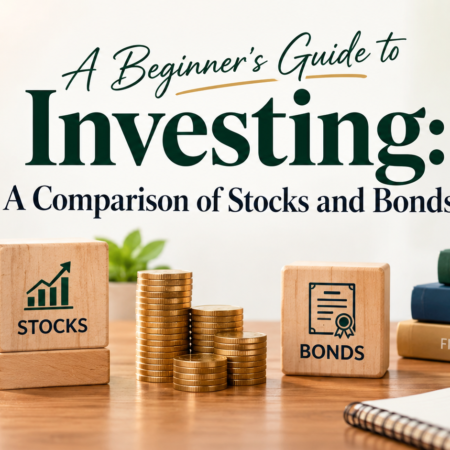
One of the most popular strategies for achieving long-term financial objectives is investing. Knowing your alternatives for investments can help you make smarter financial decisions, whether your goal is to accumulate wealth, save for retirement, or generate more income. Bonds and equities are two of the most popular investing alternatives. Both can be significant components of an investment portfolio, but they operate differently and have varying degrees of risk and possible reward.
Understanding the distinction between stocks and bonds is a crucial first step for novices looking to develop a well-rounded financial strategy. Bonds often entail lending money to a business or government in exchange for interest payments, whereas stocks allow investors to acquire a small share of a corporation. You can determine which options could suit your financial objectives, investment schedule, and risk tolerance by understanding how these assets operate.
Stocks: What Are They?
Ownership in a corporation is represented by stocks. Buying stock in a corporation makes you a shareholder, which means you have a tiny stake in the company. If the business does well, grows, makes more money, or draws in new investors, the value of your investment can rise.
Consider, for instance, that you pay $50 for each share of a corporation. The value of your investment has improved by $20 per share if the share price increases to $70. Before deducting fees and taxes, you might make money if you choose to sell at that price. Stock prices might, however, also drop. Your investment loses value if the share price drops to $35, and you would lose money if you sold at that price.
Additionally, some businesses give dividends to their owners. Companies may pay dividends from their profits or other available funds. Some investors reinvest these dividends to buy more shares, while others use them as an extra source of income. Dividend payments are not assured, and not all businesses pay dividends.
The possibility for long-term gain in equities is one of the primary motivations for investors. Over time, profitable companies may grow and make more money, which could raise the share price. Individual businesses, however, may encounter shifting market conditions, lose clients, or face financial challenges. Because of this, stock investments can be erratic, particularly in the short term.
Bonds: What Are They?
In general, bonds are a type of borrowing. You are lending money to a company, government, or municipality when you buy a bond. In exchange, the issuer usually consents to pay interest in accordance with the bond’s conditions and, if the issuer fulfils its responsibilities, repay the principle amount when the bond matures.
Assume, for instance, that you buy a bond with a $1,000 face value and a 4% annual interest rate. You would typically get $40 a year if the bond paid interest. If the issuer does not default and the bond’s terms remain unchanged, it is anticipated to refund the $1,000 principal when the bond matures.
Bonds are frequently thought to be less volatile than stocks, especially when comparing individual company shares with premium bonds. This does not imply that bonds are entirely secure, though. Issuers may neglect to pay interest or return the principal, and their value may fluctuate in response to changes in interest rates. The bond’s terms, maturity, market circumstances, and issuer’s financial stability all affect the degree of risk.
Investors looking for comparatively steady investments sometimes employ government bonds issued by financially sound countries. Conversely, corporate bonds enable companies to borrow funds from investors. Because investors are assuming more credit risk, bonds issued by corporations with lower credit ratings may have higher interest rates.
The Primary Distinction Between Bonds and Stocks
The relationship between the investor and the company receiving the funds is the primary distinction between stocks and bonds. A bond investor often becomes a lender to the bond issuer, whereas a stock investor becomes a partial owner of a corporation.
When a business expands and gains value, investors could profit. They might also be able to vote and get dividends, depending on the kind of shares they own. However, stock prices can drop dramatically, and stockholders are not assured a return. Bondholders and other creditors often have a greater claim on a company’s remaining assets in the event of bankruptcy than do shareholders.
Bondholders may receive their principal at maturity and often receive interest payments under the terms of the bond arrangement. Ownership rights in the issuing corporation are typically not granted to them. Bondholders may have a greater legal claim than shareholders if the issuer has financial difficulties, albeit complete investment recovery is not assured.
The way returns are produced is another significant distinction. Bonds typically generate returns through interest payments and shifts in their market value, whereas stocks can provide returns through dividends and price growth. Both investments have the potential to increase or decrease in value, but the causes may be different
Bonds vs. Stocks: Comprehending Investment Risk
One of the most crucial aspects to take into account when contrasting stocks and bonds is risk. Because their values are influenced by a variety of factors, including market sentiment, investor expectations, company performance, and economic conditions, stocks can undergo significant price swings. Even when a corporation is financially sound, stock prices can drop sharply during uncertain times.
Numerous hazards have an impact on bonds. Interest rate risk is one important component. Existing bonds with lower interest rates typically lose appeal when market interest rates rise, which lowers their market valuations. Existing bonds with relatively higher interest rates may increase in value when market interest rates drop.
Another crucial factor is credit risk. A government or business that issues a bond may go into financial trouble and be unable to fulfilll its obligations. In order to reward investors for taking on more risk, bonds with lower credit ratings frequently have higher yields. Nevertheless, a bond is not always a better investment just because it has a larger yield.
Bonds and stocks can both be impacted by inflation. The buying power of investment returns declines as living expenses grow. During times of strong inflation, fixed interest payments may lose some of their real value. If companies can raise prices and continue to be profitable, stocks may occasionally provide long-term protection against inflation, but this is not a given
Additionally, investors should keep in mind that even if the issuer keeps up its pledged payments, the market price of a bond may change. Although holding a single bond until maturity may lessen the significance of short-term price fluctuations, it does not remove credit risk, inflation risk, or the potential need to sell before maturity.
Possible Profits from Bonds and Stocks
Because investors have a say in whether businesses succeed or fail, stocks are frequently linked to stronger long-term growth potential. Over time, a business that boosts profits, creates new goods, or enters new markets may gain in value. Long-term holders of diversified stock investments may profit from business expansion and economic expansion.
Higher potential returns, however, are accompanied by uncertainty. Profits from stocks are not guaranteed, and the stock market may experience prolonged periods of bad performance. It could be challenging for investors who will need their money soon to deal with abrupt drops without having to sell at a loss.
When issuers are still able to pay their debts, bonds often offer more stable payment schedules. Bonds can be used by investors to produce income and lessen the volatility of a portfolio that is mostly composed of stocks. However, interest rates, purchase prices, credit quality, and the amount of time left until maturity can all affect bond returns.
Differentiating between a bond’s yield and coupon rate is crucial. The yield represents the return implied by the bond’s market price and other pertinent elements, whereas the coupon rate establishes the interest payment based on the bond’s face value. Purchasing a bond at or below face value may have an impact on the investor’s return if the bond is kept until maturity.
In every market scenario, neither stocks nor bonds are certain to perform better than the other. Investors frequently think about owning both asset classes rather than depending just on one as their relative performance varies over time.
The Reasons Behind Stock Purchases
Long-term wealth accumulation is a major reason why many investors select equities. Stocks may be an element of an investing strategy for those saving for retirement, eventual financial independence, or other long-term objectives. Although it may not completely remove the danger of losses, a longer investment timeline may offer more chances to recover from market downturns.
Investors seeking exposure to specific industries, such as technology, healthcare, consumer goods, or renewable energy, may also find stocks appealing. Investing in businesses in several industries might offer chances to profit from several economic sectors.
The potential to earn dividends while profiting from share price increase is another factor that influences investors’ decision to purchase stocks. Although dividend-paying businesses could offer an extra stream of income for investors, the stock price may still drop and their payouts may fluctuate. Instead of selecting a stock solely on the basis of its dividend yield, investors should assess a company’s financial standing.
Investing in equities requires patience and a realistic understanding of risk, despite their potential for growth. Investors may purchase at high prices and sell during downturns if they base their judgements on transient market fluctuations or emotional responses. A steady, long-term strategy could help investors steer clear of some typical blunders.
The Reasons Bonds Are Selected by Investors
Those who value consistent income, reduced volatility, or a more diversified investing portfolio could find bonds appealing. Bonds can be used by retirees and other investors to support their cash-flow needs when they need to pay for continuing expenses. A bond’s appropriateness is determined by its yield, maturity, credit rating, and the investor’s financial situation.
Depending on the issuing government and the currency, government bonds are typically regarded as lower-risk than many corporate bonds, which is why some investors prefer them. Although the rates on corporate bonds may be higher, the issuers may be more vulnerable to credit risk. Before buying any kind, investors need be aware of these distinctions.
Additionally, bonds can aid with portfolio diversification. Bonds and stocks don’t always react to changes in the economy in the same way. Bond prices may be able to counteract declining stock prices in certain market conditions. In other times, stocks and bonds may fall together, particularly when both markets are impacted by inflation and rising interest rates.
Just because a bond is a bond does not mean that it is safe. Bonds with complicated terms, long maturities, and lower-quality corporate bonds can all be quite risky. It is crucial to comprehend the bond’s structure and the issuer’s capacity for repayment.
Is It Possible to Invest in Both Bonds and Stocks?
It is possible for investors to own bonds and equities in the same portfolio. In actuality, a popular strategy for diversification is to combine various asset classes. While bonds may offer income and assist reduce portfolio volatility, stocks may offer long-term growth potential. Individual objectives, risk tolerance, financial obligations, and investment timeframe all influence the ideal mix.
For instance, a younger investor who plans to retire several decades from now can select a portfolio that has a higher percentage of diversified companies because they will have more time to weather market swings. A portfolio with a higher proportion of high-quality bonds may be preferred by an investor who is getting close to retirement in order to support planned withdrawals and assist control volatility.
These are not universal guidelines, but rather broad instances. Due to their financial situation, some younger investors could require a more cautious approach, whereas some retirees might feel more at ease taking on more investing risk. Whether the portfolio meets the investor’s real demands is a crucial factor.
Purchasing individual assets or utilising mutual funds and exchange-traded funds, or ETFs, are two ways that investors can increase their exposure to stocks and bonds. Bond funds may hold a range of corporate or governmental bonds, whereas stock funds may hold shares in numerous businesses. Although they still entail market risk, funds can make diversification more accessible. However, their fees and investment techniques should be carefully examined.
How to Pick Between Bonds and Stocks
Knowing your financial objectives is the first step in deciding between stocks and bonds. Stocks might be a significant part of your portfolio if your main goal is long-term wealth growth and you can withstand significant swings. Certain high-quality bonds might be more suited for some of your demands if you value income and reasonably reliable payments.
The timing of your investments is crucial as well.In general, funds required for an immediate expense shouldn’t be subjected to needless market risk. Bonds can lose value as interest rates rise or credit conditions worsen, and stocks can drop precipitously over brief periods of time. Before selling an investment, investors should think about whether they can afford to wait for it to recover.
Tolerance for risk is equally crucial. While some people can stay composed during a market slump, others might find it unsettling to see the value of their investments decline. Even if an investment strategy appears appealing on paper, it could be challenging to stick with if its fluctuations generate ongoing anxiety. Maintaining a long-term plan can be made simpler by striking the right balance.
Prior to making an investment, think about keeping an emergency fund, keeping an eye on high-interest loans, and being aware of the costs and taxes related to certain assets. The amount of risk you can properly take can be influenced by certain financial fundamentals. A knowledgeable financial expert could assist you in weighing your options if your circumstances are complicated
Typical Errors to Avoid When Purchasing Bonds and Stocks
One frequent error is believing that bonds never lose money or that stocks always yield higher returns. Both presumptions are false. Bond investments may lose value due to issuer defaults, inflation, or fluctuations in interest rates, while stock markets may go through protracted downturns.
Investing just on the basis of recent performance is another error. A class of assets that has done well in the last year might not do so in the future. Market circumstances are subject to change, and previous performance does not ensure future outcomes. Instead of attempting to forecast every market action, investors should concentrate on their long-term objectives.
and taxes may eventually lower net returns. Investing excessively in a single business, sector, or bond issuer might put an investor at needless danger. While diversification can lessen the impact of issues impacting a certain investment, it cannot completely prevent losses.
Lastly, during uncertain times, investors occasionally make emotional choices. A well-thought-out strategy may be compromised by selling investments in a panic or by continuously altering tactics. Investors may find it easier to stay focused on their financial goals if they comprehend the purpose of each investment and occasionally evaluate the portfolio.
Concluding Remarks
Although they have different uses, stocks and bonds can both be helpful instruments for creating a financial future. In addition to offering the chance for long-term gain and the potential for large losses, stocks symbolise ownership in firms. Bonds include risks associated with interest rates, inflation, and credit quality, but they also typically represent loans to governments or businesses and may offer scheduled interest payments.
The question of whether stocks or bonds are superior cannot be answered in a single way. Your financial objectives, time horizon, income requirements, and risk tolerance will all influence the best decision. Although the ideal ratio varies from person to person, many investors discover that a diverse blend of both gives a workable method to combine growth and stability.
Understanding what they are investing in before making a financial commitment is the most crucial stage for novices. Investors may make better decisions and advance their long-term financial objectives by understanding how stocks and bonds operate, identifying their risks, and creating a plan that works for them.
Disclaimer: This content is meant only for educational purposes and does not offer personalised financial, investing, or tax advice. Every investment carries some risk, including the potential for principal loss. Before making an investment, think about your unique situation.
Other Articles

ETF Investing for Novices: An Easy Guide to Beginning
Investing for Novices: An Easy Guide to Beginning
No Comment! Be the first one.