

Overview
Have you ever wondered how some people manage to increase their savings over time without making frequent substantial additions? Compound interest is one of the fundamental ideas of long-term wealth growth. It enables your money to grow from the interest you earn along the road in addition to the initial amount you save or invest. This procedure has the potential to significantly impact your financial future over time.
You can save, invest, and manage your money more wisely if you understand how compound interest operates. Compound interest is a crucial idea to comprehend whether you are learning the fundamentals of personal finance, creating a high-yield savings account, or making contributions to a retirement account.
Compound Interest: What Is It?
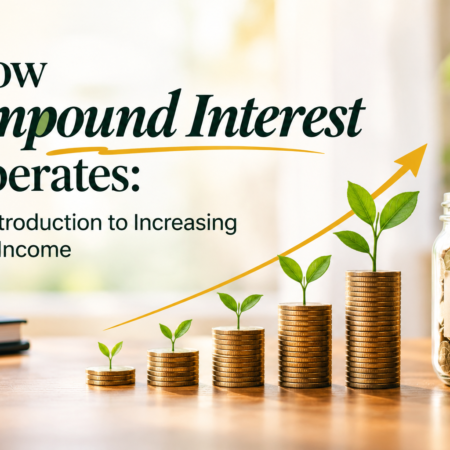
The interest you receive on both your initial investment and the interest that has previously accrued is known as compound interest. To put it simply, your money accrues interest, which then starts to accrue interest of its own. Your funds may increase more quickly over time as a result of this compounding effect.
Let’s say you put $1,000 into a savings account with a 5% yearly interest rate. You would receive $50 in interest after a year, increasing your amount to $1,050. You would receive interest on the new sum of $1,050 throughout the course of the second year rather than just interest on your initial $1,000.
In the second year, you would make $52.50 at the same interest rate.
At first, the difference might not seem like much, but as the years go by, it becomes more apparent. The amount of interest you receive may rise in tandem with your balance. Compound interest is a very effective strategy for long-term financial growth because of this.
How Is Compound Interest Calculated?
In order to include earned interest into future interest computations, compound interest works by adding earned interest to your account balance. The procedure is repeated on a daily, monthly, quarterly, or annual basis, depending on the account’s compounding schedule.
Let’s say you have $2,000 in an account with a compound yearly interest rate of 4%. Your balance is $2,080 after the first year. You receive interest on $2,080 after the second year, making the total $2,163.20. Your balance increases to almost $2,249.73 by the conclusion of the third year.
Even while the interest rate stays the same, you’ll see that the interest earned rises a little every year. This occurs as a result of the interest earned in prior years being included in the account balance.
Your money has more opportunity to compound the longer you keep it in an interest-earning account. The interest rate, compounding frequency, account fees, taxes, and whether you make further contributions or withdrawals all affect the actual outcomes.
An explanation of the formula for compound interest
You may estimate how much money you might have after a specific amount of time by using the compound interest formula. It takes into account your starting balance, interest rate, and the duration of your deposit or investment.The following formula is frequently used to compute compound growth with a constant yearly rate and annual compounding:
P(1 + r)^t = A
In this formula, t is the number of years, r is the yearly interest rate represented as a decimal, P is the starting amount of money, and A is the end sum.
For instance, your balance would increase to about $8,144.47 if you deposit $5,000 into an account that earns 5% annual interest compounded annually and leave it untouched for ten years. This indicates that if you didn’t make any more contributions, you would receive roughly $3,144.47 in interest.
This computation is predicated on a fixed interest rate, no fees, no taxes, and no withdrawals. Actual account earnings can vary, especially if interest rates fluctuate over time.
Comparing Compound and Simple Interest
Simple interest or compound interest can be used to compute earnings on savings or investments.
Interest is solely computed on the initial sum of money when using simple interest. Interest is computed on the initial sum plus interest that has already accrued when using compound interest.
Let’s take an example where you deposit $1,000 for ten years at a fixed annual interest rate of 5%. You would make $50 annually with simple interest, for a total of $500 in interest. $1,500 would be your ultimate balance
After ten years, your amount would increase to about $1,628.89 with annual compounding at the same rate. Because your prior interest profits would likewise yield returns, you would get roughly $628.89 in interest.
Over longer time periods, the disparity becomes more noticeable. While compound interest might yield ever-larger returns as the balance increases, simple interest yields a consistent amount of interest on the initial principal.
The Significance of Time in Compound Interest
One of the most crucial elements of compound interest is time. Your money has more time to grow if you start investing or saving early. When tiny sums are invested or deposited and generate steady returns over a long period of time, they can gain significance.
Think about the difference between someone who starts saving in their forties and someone who starts in their twenties. The person who starts sooner typically has a big advantage because their money has more time to compound if both earn the same rate of return and make comparable contributions.
For this reason, financial advisors frequently advise individuals to start retirement savings as soon as feasible. To reap the benefits of compound growth, a substantial starting balance is not always necessary. Time and consistency can be just as crucial as the starting sum.
Compound interest does not, however, ensure that every investment will increase. While assets like stocks and mutual funds are subject to market risk and may lose value, savings accounts may pay a specified interest rate.
Interest Rates’ Impact on Compound Growth
The rate at which your money compounds is determined by the interest rate. When everything else is equal, a higher rate typically results in higher growth. Because less interest is applied to the balance during each compounding period, a lower rate results in slower growth.
Take $5,000 deposited for 20 years with annual compounding and no further contributions, for instance. At a fixed 3% annual rate, the balance would rise to roughly $9,030. It would increase to almost $16,036 at a fixed 6% yearly rate.
This illustration demonstrates how, over time, even a few percentage point difference can have a significant effect. A greater advertized rate is not the only thing to take into account, though. You should also consider account fees, minimum balance requirements, withdrawal limitations, and whether the rate is fixed or variable.
The annual percentage yield, or APY in the US, for savings accounts represents the impact of compounding over a 12-month period. You can determine which qualifying savings account offers a more competitive yearly return by comparing APYs.
How Your Money Is Affected by Compounding Frequency
The frequency at which interest is applied to your balance is known as compounding frequency. Interest may compound on a daily, monthly, quarterly, or annual basis, depending on the financial product.
Because interest is added to the account more frequently, more frequent compounding typically results in a somewhat bigger balance while the nominal yearly interest rate remains the same. This makes it possible for previously credited interest to start earning interest earlier.
For instance, depending on whether interest compounds monthly or annually, an account with a reported annual interest rate of 5% may yield different outcomes. If the account terms let it, interest is computed and credited more regularly with monthly compounding.
Over brief periods of time, the difference in earnings from compounding frequency is frequently negligible. However, it can support further growth over longer time periods. Instead of depending just on the stated interest rate when comparing accounts, consider the annual percentage yield (APY), which takes compounding into account.
How to Increase Savings with Compound Interest.
Building an emergency fund, saving for a house, getting ready for retirement, or putting money aside for future costs are just a few of the financial objectives that compound interest can help with. Selecting an account or investment that fits your objectives, timeframe, and risk tolerance is the first step.
An interest-bearing savings account can provide you access to your money while earning interest, making it suitable for short-term savings. Although rates and account terms differ between financial institutions, a high-yield savings account might provide a more competitive annual percentage yield (APY) than a conventional savings account.
Retirement funds and diverse investments may offer compound growth prospects for long-term objectives. Different tax laws, costs, hazards, and withdrawal requirements apply to these options. Investment returns are not assured, and the value of investments may increase or decrease.
The compounding effect can also be strengthened by making consistent donations. Future interest may be computed on a bigger amount if you regularly contribute money to your balance. When paired with time and an appropriate savings plan, even small deposits can help you advance.
Debt and Compound Interest
Although compound interest might increase savings, it can also increase the cost of some loans. The amount owing may increase more quickly when interest charges are added to an outstanding balance and future interest is computed on that higher balance.
One significant example is credit card debt. Depending on your card’s terms and payment history, interest charges may raise the amount you owe if you have an outstanding balance. Unpaid interest charges may raise the balance on which subsequent charges are computed, and some credit cards compute interest using a daily periodic rate.
Paying off high-interest debt can therefore be a crucial component of a financial strategy. Interest expenses can be minimised by making on-time payments, paying more than the minimum when feasible, and cutting back on new borrowing.
Understanding the particular conditions of a loan or credit account is also crucial. Certain loan products have different methods for calculating or capitalising interest, and not all of them compound interest in the same way.
Typical Errors to Avoid in Compound Interest Understanding
Making the assumption that compound interest would yield the same outcome in every financial instrument is a frequent error. In actuality, investment returns vary according to market conditions, and savings accounts may have stated rates that change over time. Fixed-rate calculations are guesses rather than assurances of future outcomes.
Ignoring taxes and fees is another error. While taxes may lower the amount of interest or investment income you retain, account maintenance costs may lower the amount of money available to earn interest. You can evaluate your future growth more realistically by reviewing account terms.
Additionally, some people undervalue the significance of getting started early. If you wait a few years to start saving, you will miss out on important compounding period. Even while it’s never too late to start, starting earlier can increase your money’s growth potential.
Lastly, do not select a financial product solely on the basis of its promised return. Before choosing, take into account its availability, risk, costs, minimum balance requirements, and fit with your financial objectives.
Is Compound Interest a Suitable Approach for Novices?
By itself, compound interest is not a financial product. Money can expand when interest or returns are earned over time, according to a mathematical process. Understanding this procedure can help novices approach investing and saving more easily.
Setting a reasonable savings target, selecting a suitable account, and making consistent, budget-friendly contributions are good places to start. You may estimate how your balance might increase under various interest rates and time periods by using an online compound interest calculator.
Keeping short-term savings and long-term investments apart is also beneficial. Depending on your situation and risk tolerance, funds meant for long-term objectives might be more suited for alternative financial options, while funds needed in the near future might belong in a reasonably accessible savings account.
The most crucial lesson is that big initial deposits are not always necessary to generate wealth. You can benefit from compound growth with a well-thought-out plan, regular savings, and enough time.
In conclusion
One of the most helpful ideas in personal finance is compound interest, which illustrates how money can increase by earning interest on both the initial sum and interest that has already accumulated. This procedure has the potential to significantly impact long-term financial planning and savings over time.
Your initial investment, interest rate, frequency of compounding, and the amount of time your money has to grow are all important considerations. Frequent donations could raise your balance even more, and the outcome could be impacted by fees, taxes, withdrawals, and fluctuating interest rates.
Knowing compound interest can help you make better financial decisions whether you’re saving for a big purchase, creating an emergency fund, or getting ready for retirement. You can place yourself in a better position to work toward your long-term objectives by starting early, saving regularly, and selecting financial products that suit your circumstances.
Disclaimer: This essay should not be interpreted as personal financial advice; rather, it is intended solely for educational reasons. There are differences in financial products, interest rates, fees, and tax treatment. Review the terms of any investment or account before making any financial decisions.
An Introduction to Raising Interest on High-Yield Savings Accounts

No Comment! Be the first one.